







Most baby socks don't make it through the first year. They fall off on stroller walks, disappear under car seats, and get lost in the wash. Parents replace them. Then replace them again. It's one of those small, constant expenses that add up without anyone really noticing — and one of those small, constant waste streams that add up the same way.
It's not a dramatic problem. But it's a solvable one.
The hidden cost of footwear that falls off
A pair of booties that stay on gets used until it's outgrown. A pair of socks that doesn't stay on gets replaced, sometimes multiple times, before a baby's first birthday. Each replacement is a new purchase, with new packaging and shipping. Multiply that across a year, and the waste adds up faster than most people expect.
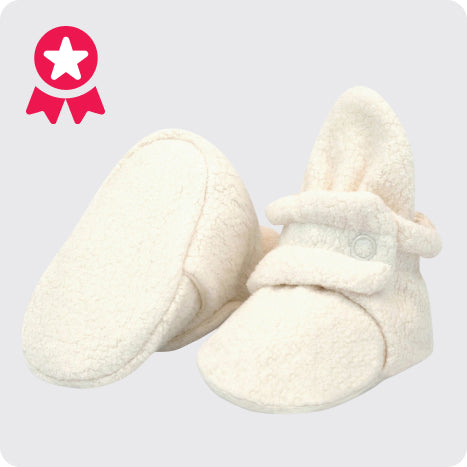
Zutano's two-snap closure exists to solve exactly this. It's a simple, adjustable design that keeps booties on a baby's feet through tummy time, stroller walks, and everything in between — until they actually outgrow them. No searching under seats. No replacing a single lost bootie. No buying the same pair twice.
That's the most straightforward sustainability argument we can make: a product that stays on is a product that doesn't need to be replaced.
What GOTS certification actually means
Not all organic cotton is the same. GOTS — the Global Organic Textile Standard — is the certification that covers the full supply chain, from how the cotton is grown to how the finished garment is made.
To earn it, every stage has to meet strict requirements: farming without toxic pesticides or synthetic fertilizers, processing without harmful chemicals, and production under fair labor conditions.
For parents, that means the fabric against their baby's skin was produced without the chemical load that conventional cotton carries. For the planet, it means a significantly lower environmental footprint at every step.
Zutano's Organic Cotton Booties and Clothing are made with GOTS-certified 100% organic cotton. It's not a marketing claim; it's the baseline for what we put on babies.
Why organic cotton matters for newborn skin
Newborns spend their first weeks in almost constant contact with fabric. Their skin is thinner and more sensitive than adult skin, which means what's in the fabric matters more than most people realize.
Conventional cotton is one of the most chemically intensive crops in the world. Residual pesticides, synthetic dyes, and chemical finishing agents can remain in fabric after processing. For newborns with sensitive skin or a family history of eczema or allergies, that's a meaningful consideration.
Organic cotton removes that variable. It's softer, it breathes better, and it gets softer with every wash — which matters for something that gets laundered as often as baby clothing does.
Durability is a sustainability feature
A product that lasts is a product that doesn't get replaced. This is one of the simplest sustainability principles, and one that the baby apparel industry consistently underdelivers on.
Zutano booties are built to hold up. High-density organic cotton and reinforced stitching keep them intact through dozens of wash cycles, not just a few. The two-snap closure holds its shape and function over time, so the fit stays adjustable and secure long after the first wash.
That durability makes them genuinely well-suited for passing down. A pair that holds up through one baby can go straight to a younger sibling, a friend's newborn, or a local clothing exchange without losing its function. One less pair manufactured. One less pair shipped. One less pair in the waste stream.
Buy less, buy better
The nursery doesn't need thirty onesies. It needs a small number of well-made pieces that cover what a baby actually needs.
For footwear, that's straightforward. Organic cotton booties for everyday wear — lightweight, breathable, soft against newborn skin. Cozie fleece booties for cooler days — warm, durable, built for stroller walks and colder months. Three or four pairs across both covers most of what a baby needs in the first year, and beyond — Zutano booties are sized from newborn through 24 months.
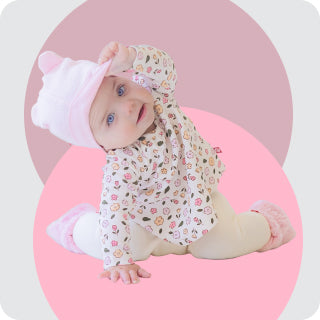
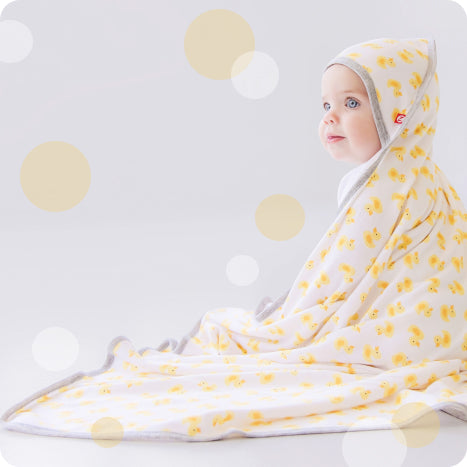
The same principle applies to clothing. A few well-made organic cotton basics and Cozie fleece pieces will outlast and outperform a larger volume of cheaper alternatives. Fewer replacements. Less waste overall.
The bigger picture
Every pair of booties that stays on doesn't get lost and replaced. Every GOTS-certified garment is one produced without the chemical load of conventional cotton farming. Every well-made piece that gets handed down doesn't enter the waste stream.
These are small decisions. But they're easy ones — not a sacrifice, just a better choice that holds up for years.


Leave a comment