







There is a particular kind of label that appears on baby products with enough frequency that it begins to lose meaning. GOTS-certified is one of them. It surfaces on hang tags, product pages, and brand copy with the quiet confidence of a term that assumes you already know what it means — or that you'll take it on faith.
Most people do. And most of the time, that's fine. But for parents making decisions about what touches a baby's skin for the better part of every day, understanding what the certification actually covers, and what it doesn't, is more useful than taking the label at face value.
What the standard actually requires
GOTS stands for Global Organic Textile Standard. It is an international certification framework that governs the production of organic textiles from the point of raw fiber through the processing of finished fabric.
The standard operates on two levels. The first concerns agriculture: cotton must be grown without synthetic pesticides, herbicides, or fertilizers, and must meet the organic farming requirements of the country in which it is produced. The second concerns processing: the facilities responsible for spinning, dyeing, and finishing the fabric must meet defined requirements for chemical inputs, wastewater management, and labor conditions.
Crucially, both levels must be verified by an accredited, independent third-party certifier. The standard does not permit self-certification. Every stage of the textile supply chain is subject to audit — not as a courtesy, but as a condition of the label.
This is the distinction that separates GOTS from the broader vocabulary of "natural" and "eco-friendly" that moves through the baby product market largely unverified.
The case for paying attention to conventional cotton
Cotton is among the most chemically intensive crops in global agriculture. Conventional production relies heavily on synthetic pesticide and fertilizer inputs — and the consequences of that reliance do not end at harvest. Chemical residues persist through processing, and the processing itself introduces a further range of inputs: synthetic dyes, softening agents, finishing treatments applied for wrinkle or shrink resistance. The regulatory framework governing these treatments varies significantly by country and by stage of production.
For adults, this sits at some remove from daily life. For babies, the calculus is different.
Why the calculus is different for babies
Infant skin is not simply adult skin at a smaller scale. It is structurally distinct — thinner, with a higher surface-area-to-body-weight ratio, and meaningfully more permeable. It absorbs a greater proportion of what it contacts, and it is less equipped to process or metabolize chemical exposures than mature skin.
Alongside this, babies spend an extraordinary amount of time in sustained, direct contact with fabric. Sleeping, being carried, lying on play surfaces — the daily accumulation of skin-to-fabric contact is categorically different from what an adult experiences.
The combination of increased permeability and sustained exposure is the reason that material standards matter more here than in almost any other category of clothing. GOTS addresses this by requiring verified control over chemical inputs at every stage of the fabric's production — not only in the field, but through every processing step that follows.
A garment made from GOTS-certified fabric is not simply one whose cotton was grown without pesticides. It is one whose entire material supply chain has been audited against a defined standard by a party with no commercial interest in the outcome.
What to look for when shopping
The word "organic" on a baby clothing label is not, on its own, a verified claim. Terms like "natural," "eco-conscious," or "made with organic cotton" exist outside any standardized certification framework. They are marketing language, and they carry no audit requirement.
GOTS is a named, third-party verified standard. The difference is material.
When evaluating a claim, it is worth asking what specifically is certified — the fiber, the fabric, or the finished garment — and by whom. For those who want to verify independently, the GOTS database at global-standard.org allows direct searches of certified facilities.
How Zutano approaches it
Zutano's organic cotton pieces — booties, clothing basics, sun hats — are made from GOTS-certified organic cotton fabric. The certification applies to the material itself: to the cotton from which it is grown, and to every stage of the fabric's processing.
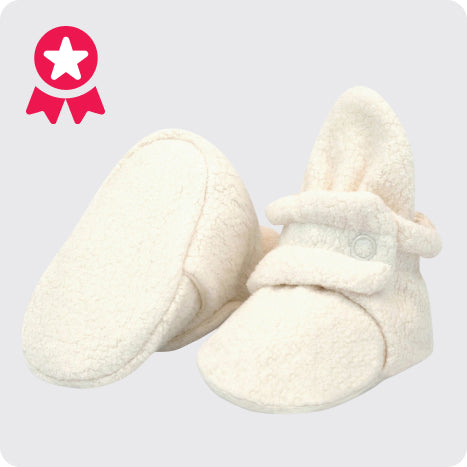
For booties, that fabric is in sustained contact with a baby's feet and lower legs throughout the day. The two-snap closure is what keeps them on; the material beneath that closure has been produced to a verified standard.
For sun hats, the same fabric sits against a baby's head and face during outdoor time — precisely the intersection where sun protection and prolonged skin contact are both in play.
The certification does not alter the design or appearance of these pieces. It is a material standard — an account of what the fabric is, and the conditions under which it was made.
The essential point
GOTS-certified fabric means the cotton was grown without synthetic chemical inputs and processed without harmful treatments — independently audited at every stage of production.
For baby clothing specifically, this matters because infant skin is more permeable, because babies sustain more fabric contact time than almost any other population, and because they cannot communicate when something is wrong.
A label that has been externally verified offers a more reliable basis for decision-making than one that has not. That is, in the end, what GOTS is: a verified claim in a category where verification is rarer than the language on the label tends to suggest.
This content was developed by the Zutano team, drawing on publicly available information about the Global Organic Textile Standard. For specific questions about fabric sensitivities or your baby's skin, consult your pediatrician. For full certification details, visit global-standard.org.


Leave a comment